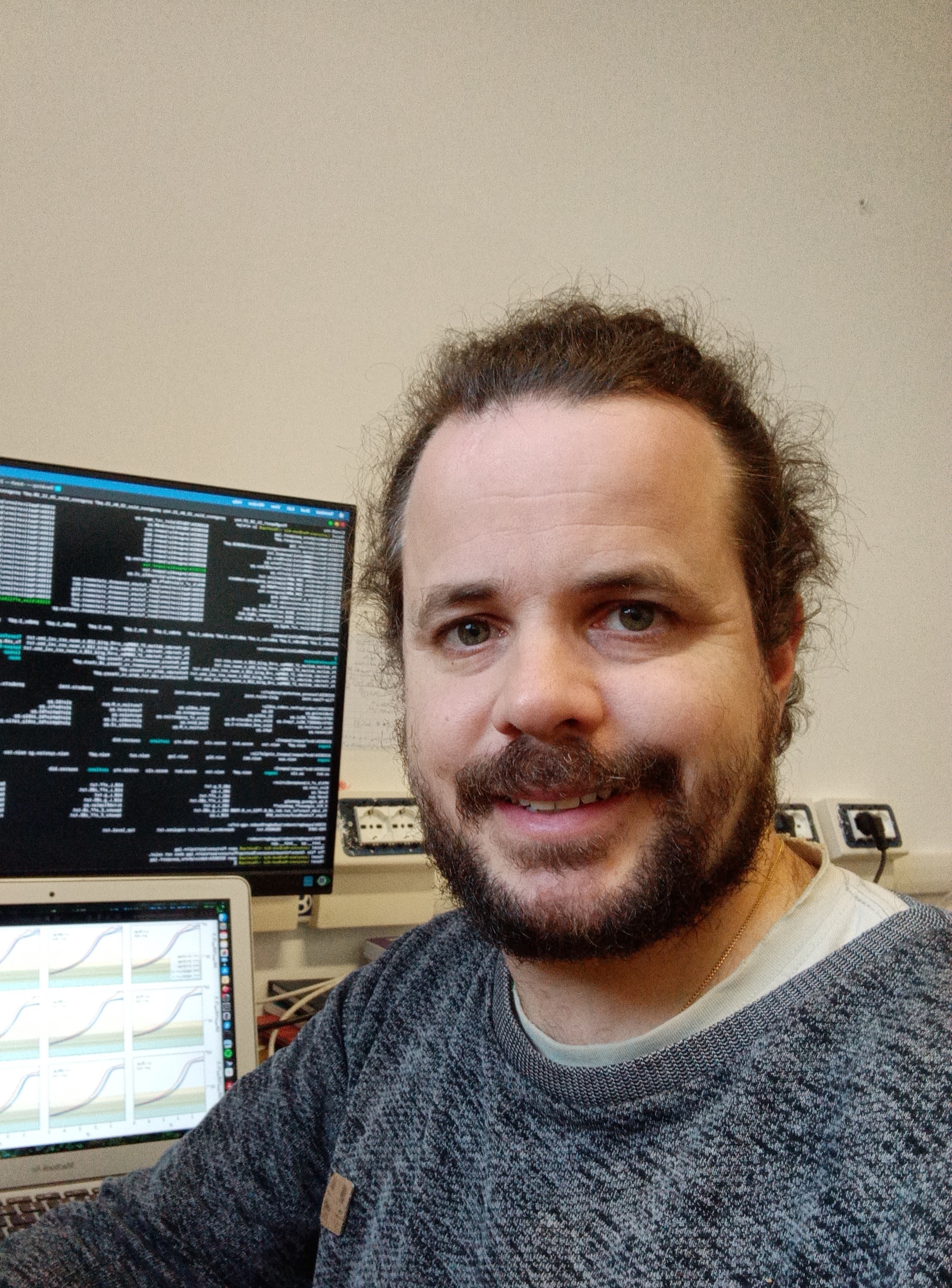
Welcome!
I am Titouan Lazeyras, a postdoctoral researcher in numerical astrophysics and cosmology at the University of Milano-Bicocca. This is my personal professional webpage. Here, you can learn about my research interests or have a look at my CV. You can also find my list of publications at the following link.
Research
My research ineterests span a variety of topics in astrophysics and cosmology, from galaxy clustering on the largest scales, new methods to constrain dark matter properties, the properties of the circumgalactic medium (CGM) or primordial black holes. You can also see the complete list of my publications at the following link.
Galaxy clustering
One of my main interest of research is galaxy clustering, in particular the relation between the density field of discrete tracers of the large-scale structure (such as dark matter halos or galaxies) to that of the underlying dark matter density field through the bias formalism.
Characterizing this relation is of pivotal importance to extract cosmological information from the observed distribution of galaxies by large redshift surveys such as BOSS, DESI, Euclid, Nancy Grace Roman or LSST.
In particular, I worked on self-consistently measuring the complete set of bias parameters up to 3rd order in perturbation theory, and first higher-order in derivative from various numerical techniques (arXiv:1511.01096, 1712.07531, 1904.11294).
I also studied assembly bias, i.e. the dependence of halo bias on properties other than the mass. I computed large-scale assembly bias using separate universe simulations and forward modelling. I also computed the impact of massive neutrinos on assembly bias (arXiv:1612.04360, 2008.12265, 2106.14713, 2209.07251).
I have also worked on constraining primordial non-Gaussianity (PNG) from galaxy clustering. I worked on consistency relations between the linear and non-Gaussian halo bias, as well as the impact of assembly bias on this relation.
Crucially, we showed that this relation can vary significantly for different galaxy populations, thus biasing constraint on PNG if not dealt with carefully. This, together with other works, paved the way for the development of new techniques to
improve the analysis of galaxy clustering data to constrain PNG, which are now used on the DESI DR1 data (arXiv:1611.04901, 2209.07251).
Dark Matter constraints
While the existence of dark matter is now well established, its exact nature remains one of the pivotal questions of modern cosmology. For example, the mass range of possible candidates spans ~80 orders of magnitude, from ultra-light particles to primordial black holes. At the University of Milan-Bicocca, I am working on developing new astrophysical probes to constrain dark matter properties from the intergalactic medium in emission. This is made possible thanks to recent deep observations of modern IFUs suh as MUSE on the VLT. For this work, I developed an entirely new suite of hydrodynamical zoom-in simulations called DaLya (DArk matter and LYman-Alpha), as well as the previously developed HELLO simulations.
Galaxies and their environment
On smaller scales, I am very interested in studying the circumgalactic medium (CGM), and its link with galaxy evolution.
I am now leading the RePhyNe (Resolving the physics of Quasar Lyα Nebulae) project which develops, with the help of cosmological simulations, a new methodology to constrain quasar host halo masses from the kinematics derived from the CGM in emission, as well as the density distribution of cold gas within the CGM of quasars.
This work also makes use of the new simulation suite DaLya (arXiv:2309.01506).
I have also taken part in numerous studies of the galaxy population around a massive node of the cosmic web using multi-wavelength observations of the MQN01 field at z=3.2.
These have revealed the connection between the growth and properties of galaxies and their environment, revealing one of the largest Lyα nebula ever discovered (tracing the cold gas acting as star formation fuel),
the largest overdensity of AGN, a large overdensity of Lyα emitters and of CO emitters.
This field is also hosting numerous quiescent galaxies as well as the largest spiral galaxy at this redshift known to date (the Big Wheel galaxy).
These discoveries make MQN01 one of the most particular field in the young Universe and an excellent laboratory to further extend our understanding of galaxy evolution (arXiv:2401.04765, 2409.17956, 2410.03822, 2410.03933, 2507.16921, 2508.20074, 2511.19608, 2601.20473)
Contact
Dr. Titouan Lazeyras
Postdoctoral Researcher
Cosmib group
Dipartimento di Fisica "Giuseppe Occhialini"
Università degli Studi di Milano Bicocca
Piazza della Scienza 3, 20126 Milano, Italy
Office: U2-2018
email: titouan.lazeyras@unimib.it